
Guinea Egg
https://www.desmos.com/calculator/rrsn0nrxcu
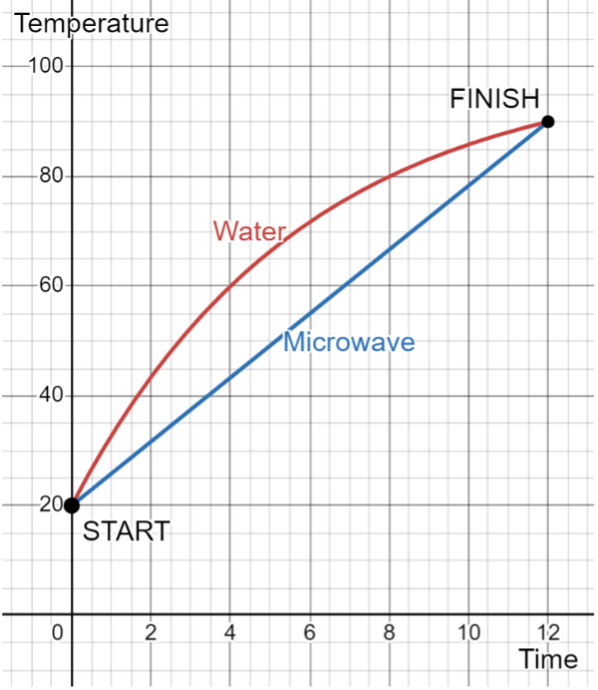
To cook a guinea egg, you need to raise its temperature to T = 90°. Guinea eggs are delicate, so this must be done slowly. There are two established methods.
The first is to put it in boiling water at a constant temperature of 100°. The second is to put it in a microwave oven at low power.
The surprising thing is, if we start with the egg at room temperature (T = 20°), the two methods have exactly the same cooking time—12 minutes.
Nevertheless, the two methods employ different forms of heat transfer and this affects the shape of the temperature-time graphs, as illustrated below. What’s going on here? This is an excellent question for the class to discuss.
How can you shorten the cooking time by moving the egg from one option to the other? Illustrate your scheme that minimizes cooking time on the graph.
Curriculum Expectations
A1. Mathematical Processes
A2. Making Connections
C3. Application of Relations
D1. Collection, Representation, and Analysis of Data
D2. Mathematical Modelling